- Details
The climate crisis has exacerbated many ecological and cultural problems including wildfire and drought vulnerability, biodiversity declines, and social justice and equity. While there are many concepts of social and ecological resilience, the exemplar practices of Indigenous stewardship are recognized in having sustained Indigenous peoples and their countries for millennia and past climate change events. California has been at the crossroads of many of these issues, and the historic and current contributions of Indigenous peoples to addressing these provide an excellent study of ecocultural stewardship and leadership by Indigenous peoples to achieve climate resilience.
- Details
Enter resource descrFrom 2024 to 2026, the CLSN will focus its efforts on the three areas. These multi-faceted, interrelated, and emergent topics build upon our strengths while allowing us to continue to be nimble and adaptive to opportunities and needs that arise from our community of practice.
- Connecting collaborative practitioners in ways that inform, equip, and empower;
- Advancing solutions to systemic barriers that limit collaborative stewardship action;
- Supporting the landscape stewardship movement that leads with equity, justice, and inclusion
Specific objectives and activities under each focal area are detailed in this report.iption/details here.
- Details
State Wildlife Action Plans (SWAPs) are fundamental for advancing connectivity conservation in the United States. To support integrating connectivity into SWAPs, the Center for Large Landscape Conservation reviewed SWAPs from the 2015 revision cycle and interviewed state wildlife planners. The intent of this report is to provide SWAP planners and partners with a comprehensive “menu” of actions and best practices that can advance connectivity conservation in the face of diverse threats.
- Details
-
We are at a pivotal inflection point for addressing landscape scale challenges in the United States and across the globe. From climate change and land-use planning to water management and environmental justice, complex and increasingly urgent issues cross political boundaries, scales, demographics, and sectors. Collaboration is paramount for successfully addressing these issues, and practitioners, funders, and researchers all have a role to play in finding and implementing landscape-scale solutions. However, even when diverse groups work together, success isn’t guaranteed.
Collaborative capacity is essential for all kinds of partnerships, groups, and networks to effectively work together. Yet even those who support this work are not entirely familiar with what collaborative capacity is, nor why it’s important. Network practitioners, funders, and researchers need more information about collaborative practice so they can partner for greater impact at scale. To help address this need, the California Landscape Stewardship Network commissioned a study that explored the elements of collaborative capacity and the essential role it plays in achieving social and ecological goals.
- Details
-
Collaborative conservation and stewardship offer effective approaches for addressing complex challenges such as climate change, biodiversity loss, and environmental justice. They also provide innovative ways to fill governance gaps and make inclusive decisions in situations for which we have no sufficient structure, processes, or abilities. However, in order to effectively allocate scarce resources, we need to better understand how to invest in the “collaborative capacity” that sustains collaborative groups, partnerships, and networks.
This study provides an analysis of what collaborative capacity is and how it leads to improved conservation and stewardship outcomes based on expert perspectives gathered from in-depth interviews and focus groups with practitioners, leaders, and funders across the United States.
We present a framework that illustrates the collaborative capacity elements that are necessary and fundable, as well as a list of activities they enable. We share the reasons why consistent, long-term investment in these elements is needed. We emphasize the contextual factors that affect collaboration so that these investments are made in the right places, at the right times, and in the right ways to achieve their potential. We end with a set of recommendations directed toward practitioners, funders, and researchers that will help align their efforts, making them more effective, efficient, and able to achieve durable outcomes.

- Details
On August 10, 2023, we were joined by four rising leaders in California to continue highlighting efforts statewide that center equity, justice, Tribal sovereignty, and inclusion in the stewardship of land, water, and communities:
- Barbara Camacho Garcia, Grassroots Ecology
- Benjamin Chang, California Climate Action Corps
- Ivette Torres, The People's Collective for Environmental Justice
- Irene Takako Farr, Better World Group
This series is hosted by the CLSN’s Justice, Equity, Diversity, & Inclusion Roundtable for Healing Severed Connections. This lunchtime conversation was moderated by JEDI Roundtable member Laurel Wee.

- Details
-
Indigenous cultures have stewarded nature for thousands of years but today's conservation approaches often sideline this knowledge – to the detriment of stewardship efforts, Indigenous peoples and the planet. In the first of a 2-part webinar series, we hear from speakers from the U.S. and Australia about the dynamics of successful partnerships between conservation organizations and Indigenous groups, both in the management of conservation lands and in Indigenous handbacks of conservation lands. The key focus is on the ‘how’: How to partner with and support Indigenous-led conservation, including best practices, strategies for reciprocity, and turning listening into action.
- Details
-
The Lincoln Institute of Land Policy, in partnership with the Network for Landscape Conservation and the University of Montana, has released a working paper exploring the role of large landscape conservation in providing nature-based climate solutions.
Land conservation addresses climate change both by mitigating greenhouse gas emissions and by helping human and natural communities adapt to the changes caused by global warming. To be most effective, land conservation strategies dealing with climate change need to be implemented at scale and typically require collaboration among many partners who need to work together to overcome obstacles like political boundaries, uncoordinated plans, competition for funding and cultural conflicts.
This paper examines the experience of collaborative partnerships in dealing with climate change. The examination draws from a recent online survey of landscape conservation partnerships, interviews with over 40 practitioners, web research, and email communications. This paper presents practices that appear to be most effective and makes recommendations that can accelerate and broaden the benefits of landscape conservation and restoration in meeting climate goals.
- Details
-
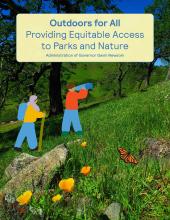
The Outdoors for All strategy charts progress on equitable outdoor access to date, highlights work underway, and identifies additional actions to realize the promise of a California for All. This strategy outlines pathways that government, community organizations, philanthropy, private sector, and residents across California can take together to continue increasing access to the outdoors and nature.
- Details
-
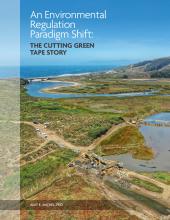
A paradigm shift is inherently complex and difficult to achieve. It is particularly challenging within a layered, multiagency regulatory environment that has been built over decades. However, it can be done. This case study examines one promising example—Cutting Green Tape (CGT)—that not only aims to increase regulatory and permitting efficiencies, but also to shift our collective thinking about how multibenefit environmental restoration projects in California can happen.
The CGT case study allows us to explore the evolution and current status of a perceived paradigm shift. This case study’s researchoriented lens and consideration of Kuhn’s seminal work on shifting paradigms (1970) reveals CGT’s progression in a way that can be applied by a wide range of professional audiences. Insights are shared with those seeking to create such a shift within regulatory (or similar) contexts.
Findings indicate that a paradigm shift for environmental restoration work in California is indeed underway. CGT is moving into the final phase of a five-phase process (see Five Phases of a Paradigm Shift). Two of the four signs of a true paradigm shift (see Four Signs of a Paradigm Shift) have been fulfilled, and there are initial indicators of progress towards the third sign of change as well. However, while promising, CGT as a new paradigm (i.e., a profound change in approach or underlying assumptions) has yet to be fully realized.