- Details
-
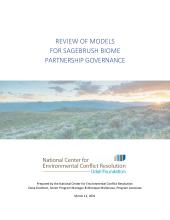
The Udall Foundation's Center for Environmental Conflict Resolution reviewed three key collaborative partnership models (the North American Wetlands Management Plan and associated Joint Ventures, the Northwest Boreal Partnership, and the Chesapeake Bay Program) and four secondary models (Blackfoot Challenge, Crown of the Continent, the National Invasive Species Council, and the Southeast Conservation Adaptation Strategy) to identify lessons learned and best practices that could be applied to the development of a collaborative partnership in the sagebrush biome.
- Details
-
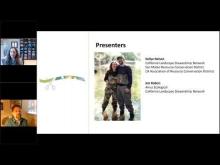
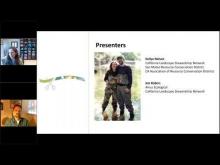
The California State Coastal Conservancy hosted a webinar on 2/3/21 with Kellyx Nelson and Jim Robins about the Cutting Green Tape initiative and why it is needed to protect our natural resources. Ms. Nelson and Mr. Robins are two of the lead authors of the Cutting Green Tape: Regulatory Efficiencies for a Resilient Environment report (November 2020) and discuss the need for changes in our regulatory processes and present the recommendations in the report. With Trish Chapman, Central Coast Regional Manager, State Coastal Conservancy.
- Details
-
Enter resource description/details here.
- Details
-
This report offers recommendations on initial steps to build resilient communities throughout California. If taken, these steps would represent an unprecedented effort to close the climate gap and invest in social infrastructure for climate resilience. The urgent need to bolster community resilience should be viewed as an opportunity to rethink the political, social, and economic structures needed to safeguard all California residents.
- Details
-
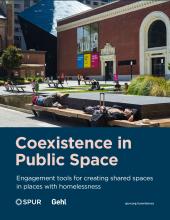
In recent years the number of people experiencing homelessness has grown rapidly in many American cities, raising new questions about who public space is designed for. As more and more Bay Area residents find themselves without homes, many have defaulted to living in public spaces such as parks, plazas and squares. These spaces were not designed to be homes, however, and housed users voice concerns that the presence of unhoused residents degrades public spaces, rendering them unwelcoming or even unsafe.
At the same time, people who do not have access to stable housing are members of the community and should not be denied the use of public space simply because of their living situation. As long as our cities do not provide housing for all who need it, our neighborhoods will continue to face the challenge of how housed and unhoused users can coexist in public space.
This report introduces the toolkit, which can be downloaded at spur.org/coexistence, and offers considerations for community discussion.

- Details
-
Connecting landscape-scale conservation partnerships through a national network will be essential to achieving the Biden Administration’s ambitious goals around biodiversity (“30 x 30” initiative), equity, and climate change. While some attempts have been made to coordinate landscape conservation efforts across the country, a robust, cohesive, nationwide network is not in effect today. We provide recommendations for building back a better national framework that supports landscape conservation efforts across the United States.
- Details
-
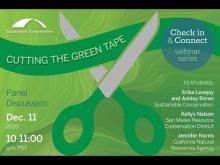
Following the release of the California Secretary of Natural Resources' Cutting the Green Tape Initiative's recommendations, we heard from restoration experts about what this initiative is, why it’s needed, and how it will help accelerate restoration and protect our natural resources and ecological systems.
Panelists:
- Erika Lovejoy, Accelerating Restoration Program Director, Sustainable Conservation
- Kellyx Nelson, Executive Director, San Mateo Resource Conservation District
- Jennifer Norris, Deputy Secretary for Biodiversity and Habitat, California Natural Resources Agency
Moderated by Ashley Boren, Chief Executive Officer, Sustainable Conservation

- Details
-
Cutting Green Tape is an initiative the California Landscape Stewardship Network has facilitated in partnership with the California Natural Resources Agency to help environmentally beneficial work happen more quickly, simply, and cost-effectively. Learn more about the initiative at: https://resources.ca.gov/Initiatives/.
This presentation on Cutting Green Tape was part of the 2020 Virtual California Association of Resource Conservation Districts Conference, held on November 12-20, 2020. Speakers included Kellyx Nelson, Executive Director, San Mateo RCD; Jennifer Norris, Deputy Secretary of Biodiversity and Habitat, California Natural Resources Agency; and Erika Lovejoy, Director – Accelerating Restoration, Sustainable Conservation.
- Details
-
The State of California has identified “Cutting Green Tape” as a signature initiative to increase the pace and scale of environmental restoration. California has a proud tradition of strong laws that protect our environment from the effects of development and resource extraction. Unfortunately, projects that are beneficial to the environment can be slowed by the same processes and procedures that are designed to protect it. Cutting Green Tape seeks to remedy this problem. This report is the product of the insights and experiences of more than150 people who gathered at a series of roundtable workshops and others to whom the authors reached out from fall 2019 to fall 2020 about ways the state can increase regulatory efficiencies to increase the pace and scale of restoration and stewardship work.
- Details
-
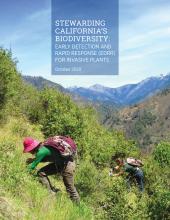
In 2018, then-Governor Jerry Brown established the California Biodiversity Initiative, setting biodiversity protection as a top state priority. The Biodiversity Collaborative is the next phase in the evolution of California’s biodiversity conservation movement, integrating and building on efforts started by the California Biodiversity Initiative launched by Governor Brown. Like California’s State Wildlife Action Plan and Climate Adaptation Strategy, the Biodiversity Collaborative identifies the importance of controlling invasive species as part of attaining a sustainable future.
Indeed, hundreds of entities across California are engaged in strategic efforts to limit the scope and magnitude of the damage that these species do to the state’s biodiversity and natural resources. When possible, land managers use a strategic approach called early detection and rapid response (EDRR) that focuses on stopping new invasive plants before they become widespread. As with a raging wildfire, a surging infectious disease, or a leaking oil pipeline, the longer one waits to act, the more difficult and costly the task and the greater the damage that has already been done.While the concept is simple, its implementation is complex. Effective EDRR requires timely data, proactive effort, landscape-level coordination among public and private landowners, and a consistent and sustained approach. In California, many pieces of an effective EDRR system are already in place, from an online network for sharing botanical information to a statewide network of land managers. But steady funding to implement EDRR systematically across the state’s 100 million acres is lacking. With the new Biodiversity Collaborative in place, the time has come for an increased commitment to invasive plant EDRR.
While technical challenges remain—such as predicting how each plant’s distribution will shift with land use and climate change—EDRR’s primary challenges are structural: How can agency missions, mandates, programs, and funding be aligned to support landscape-level conservation? This paper identifies the institutional and financial support needed for invasive plant EDRR to succeed in California.