
University of California Berkeley, August 2024
Federal environmental laws like the CAA, ESA, and NEPA overlook fire’s ecological role. This paper urges policy reforms to support fire restoration and respect Tribal sovereignty.
- Details
Enactment of the Clean Air Act (CAA), Endangered Species Act (ESA), and National Environmental Policy Act (NEPA), three of the primary federal environmental laws, all coincided with the height of fire suppression and exclusion in the United States. These laws fail to acknowledge or account for the importance of fire in many fire-adapted and fire-dependent ecosystems, particularly in the American west, or the imperative for fire restoration to improve resiliency and reduce wildfire risk as identified by western science and Indigenous knowledge. We review the statutory and regulatory provisions of these federal laws to identify how the existing policy framework misaligns with the unique role of fire in ecosystems and with Tribal sovereignty, identify specific barriers and disincentives to beneficial fire use, and propose specific policy reforms.ion/details here.
Aldo Leopold Wilderness Research Institute, August 2024
- Details
Historical and contemporary policies and practices, including the suppression of lightning-ignited fires and the removal of intentional fires ignited by Indigenous peoples, have resulted in over a century of fire exclusion across many of the USA’s landscapes. Within many designated wilderness areas, this intentional exclusion of fire has clearly altered ecological processes and thus constitutes a fundamental and ubiquitous act of trammeling. Through a framework that recognizes four orders of trammeling, we demonstrate the substantial, long-term, and negative effects of fire exclusion on the natural conditions of fire-adapted wilderness ecosystems. In order to untrammel more than a century of fire exclusion, the implementation of active programs of intentional burning may be necessary across some wilderness landscapes. We also suggest greater recognition and accommodation of Indigenous cultural burning, a practice which Tribes used to shape and maintain many fire-adapted landscapes for thousands of years before Euro-American colonization, including landscapes today designated as wilderness. Human-ignited fire may be critical to restoring the natural character of fire-adapted wilderness landscapes and can also support ecocultural restoration efforts sought by Indigenous peoples.
Center for Large Landscape Conservation, June 2024
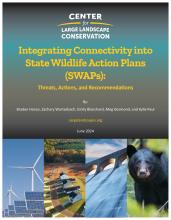
The report reviews how state wildlife plans address ecological connectivity, identifies key threats (e.g., roads, dams, development), and offers a menu of actionable steps for better integration.
- Details
State Wildlife Action Plans (SWAPs) are fundamental for advancing connectivity conservation in the United States. To support integrating connectivity into SWAPs, the Center for Large Landscape Conservation reviewed SWAPs from the 2015 revision cycle and interviewed state wildlife planners. The intent of this report is to provide SWAP planners and partners with a comprehensive “menu” of actions and best practices that can advance connectivity conservation in the face of diverse threats.
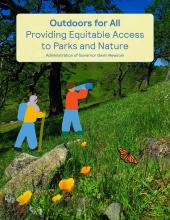
California Natural Resources Agency, May 2023
Outlines actions for equitable access to parks and nature, engaging government, communities, and philanthropy statewide.
- Details
-
The Outdoors for All strategy charts progress on equitable outdoor access to date, highlights work underway, and identifies additional actions to realize the promise of a California for All. This strategy outlines pathways that government, community organizations, philanthropy, private sector, and residents across California can take together to continue increasing access to the outdoors and nature.
Rural Voices for Conservation Coalition, February 2023
Proposes capacity-building reforms to empower community-based conservation through 2023 Farm Bill programs and authorities.
- Details
-
The reauthorization of the Farm Bill in 2023 presents a prime opportunity to ensure that federal agencies and their partners have the tools and authorities needed to maximize the use, impacts, and effectiveness of recent investments to achieve lasting conservation outcomes.
Recognizing this unique moment in time, the Rural Voices for Conservation Coalition (RVCC) convened a working group to develop recommendations for the 2023 Farm Bill. Capacity-building quickly rose to the top as our priority topic. In order to ensure the effective use of current investments, there is a need to use the power of Farm Bill programs and authorities to build capacity of community-based and collaborative partners and efforts. This capacity is crucial for developing the sustained social and physical infrastructure and the enabling conditions necessary to effectively and optimally use federal investments. Building community-based capacity in particular has been recognized as a key means of reducing barriers to access and advancing equity within U.S. Department of Agriculture programs. The recommendations below outline various strategies for Farm Bill programs and authorities that would bolster collaborative and community-based partners and efforts, both in terms of internal resources and capabilities and in their ability to use and access Farm Bill programs.