

- Details
-
Enter resource description/details here.
- Details
-
Enter resource description/details here.
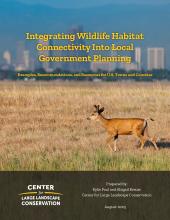
- Details
This report aims to clearly define habitat connectivity and highlight actionable strategies for integrating it into
local government planning. By incorporating habitat connectivity into policies, plans, and planning tools, local
governments can play a vital role in protecting natural systems and building healthier, more resilient communities,
now and for generations to come.The document outlines the benefits of habitat connectivity for municipalities and counties, offers practical
recommendations for incorporating ecological connectivity into local government planning and implementation,
and provides examples of plans, policies, reports, case studies, and sample language from around the country that
demonstrate how connectivity can be addressed.
- Details
This report presents the findings from the 2022 Caroline Welsh Churchill Fellowship, undertaken to advance the capacity and impact of private land conservation in Australia. The Fellowship provided an opportunity to explore innovative conservation models, financing strategies, policy mechanisms, and collaboration frameworks across the United States and Canada, with the aim of applying these insights to strengthen conservation efforts in Australia.
- Details
Collaborative approaches are often applied to today’s most complex challenges and emergent opportunities. This is certainly true for the field of landscape stewardship, the practice of conserving, restoring, and stewarding landscapes and seascapes at scale. Those working in this field recognize the value of collaboration, and while pressing questions persist, the discussion has shifted. Rather than question the value of collaboration, it is more likely to be about why and how to invest in collaborative models. The purpose of this article is to contribute to the larger conversation by introducing the Collaborative Capacity Impact Model™, a data-driven framework based on an interdependent, scalable system of 15 impacts and the process of scaling up, accelerating, and sustaining those impacts. The concept of collaboratives as a special type of organizational model is discussed, along with five key collaborative design elements.
- Details
Enactment of the Clean Air Act (CAA), Endangered Species Act (ESA), and National Environmental Policy Act (NEPA), three of the primary federal environmental laws, all coincided with the height of fire suppression and exclusion in the United States. These laws fail to acknowledge or account for the importance of fire in many fire-adapted and fire-dependent ecosystems, particularly in the American west, or the imperative for fire restoration to improve resiliency and reduce wildfire risk as identified by western science and Indigenous knowledge. We review the statutory and regulatory provisions of these federal laws to identify how the existing policy framework misaligns with the unique role of fire in ecosystems and with Tribal sovereignty, identify specific barriers and disincentives to beneficial fire use, and propose specific policy reforms.ion/details here.
- Details
Historical and contemporary policies and practices, including the suppression of lightning-ignited fires and the removal of intentional fires ignited by Indigenous peoples, have resulted in over a century of fire exclusion across many of the USA’s landscapes. Within many designated wilderness areas, this intentional exclusion of fire has clearly altered ecological processes and thus constitutes a fundamental and ubiquitous act of trammeling. Through a framework that recognizes four orders of trammeling, we demonstrate the substantial, long-term, and negative effects of fire exclusion on the natural conditions of fire-adapted wilderness ecosystems. In order to untrammel more than a century of fire exclusion, the implementation of active programs of intentional burning may be necessary across some wilderness landscapes. We also suggest greater recognition and accommodation of Indigenous cultural burning, a practice which Tribes used to shape and maintain many fire-adapted landscapes for thousands of years before Euro-American colonization, including landscapes today designated as wilderness. Human-ignited fire may be critical to restoring the natural character of fire-adapted wilderness landscapes and can also support ecocultural restoration efforts sought by Indigenous peoples.
- Details
The climate crisis has exacerbated many ecological and cultural problems including wildfire and drought vulnerability, biodiversity declines, and social justice and equity. While there are many concepts of social and ecological resilience, the exemplar practices of Indigenous stewardship are recognized in having sustained Indigenous peoples and their countries for millennia and past climate change events. California has been at the crossroads of many of these issues, and the historic and current contributions of Indigenous peoples to addressing these provide an excellent study of ecocultural stewardship and leadership by Indigenous peoples to achieve climate resilience.

- Details
Enter resource descrFrom 2024 to 2026, the CLSN will focus its efforts on the three areas. These multi-faceted, interrelated, and emergent topics build upon our strengths while allowing us to continue to be nimble and adaptive to opportunities and needs that arise from our community of practice.
- Connecting collaborative practitioners in ways that inform, equip, and empower;
- Advancing solutions to systemic barriers that limit collaborative stewardship action;
- Supporting the landscape stewardship movement that leads with equity, justice, and inclusion
Specific objectives and activities under each focal area are detailed in this report.iption/details here.