
- Details
-
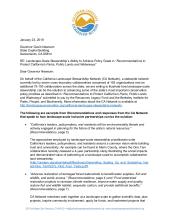
A companion letter to the Resources Legacy Fund's policy recommendations to California Governor Gavin Newsom.
- Details
-
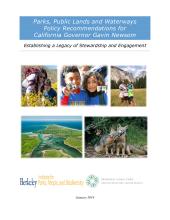
This paper identifies priority actions that California Governor Gavin Newsom's Administration can take to protect our parks, public lands, and waterways for the enjoyment of current and future generations.
- Details
-
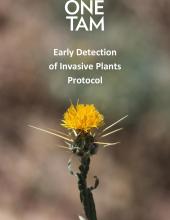
Developed in 2016 and subsequently revised, this Early Detection Rapid Response protocol serves the invasive plant monitoring needs of the One Tam agencies. While this protocol is in routine use at One Tam, it is also a living document, with occasional changes to the species list or other elements.
- Details
-
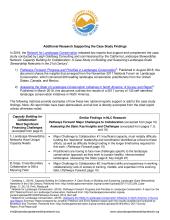
This document provides examples of how two national reports support or add to the findings of the California Landscape Stewardship Network's Capacity Building for Collaboration case study.
- Details
-
Wildfire. Drought. Flooding. Species extinction. Climate change. California faces grave threats that require bold, immediate action. An essential part of any solution is to restore and proactively manage California’s lands and natural resources at a scale and pace sufficient to result in meaningful benefits.
The purpose of this paper is to help catalyze new conversations and strategies to reduce persistent barriers to environmental stewardship, conservation and restoration of California’s lands that are unintended consequences of essential environmental regulations. It summarizes and assesses key advances in addressing these barriers—including legislative and policy approaches as well as approaches based on coordination, collaboration, and trust building—and includes recommended next steps.
This white paper includes a problem statement, key findings (p. 3), assessment of recent efforts (p.3), models outside the field of conservation (p.17), and conclusions and recommended next steps (p.19).
- Details
-
How many times have you heard someone say "we can't fundraise for stewardship?" If that's how we think about stewardship, that's how it will be. As Henry Ford said, “Whether you think you can, or you think you can't - you're right.”
The goal of this Kit is to enable anyone who wants to prioritize, value, and fund the work of taking care of the land to change the narrative about stewardship. To move away from "it can't be funded" to "it is essential that we fund and prioritize it" while staying grounded in our values, impacts, and stories.
- Details
-
"Pennsylvania’s Conservation Landscapes are an innovative framing of the conservation and stewardship of natural resources that contribute to the long-term sustainability of special regions throughout the commonwealth. Through place-based partnerships these landscape-scale initiatives are being widely recognized as models for successful collaboration in Pennsylvania and the nation."
- Details
-
Meeting Goals
- Share the vision for Cutting the Green Tape.
- Gather input to inform the overall design for the initiative.
- Establish process and confirm timeline.